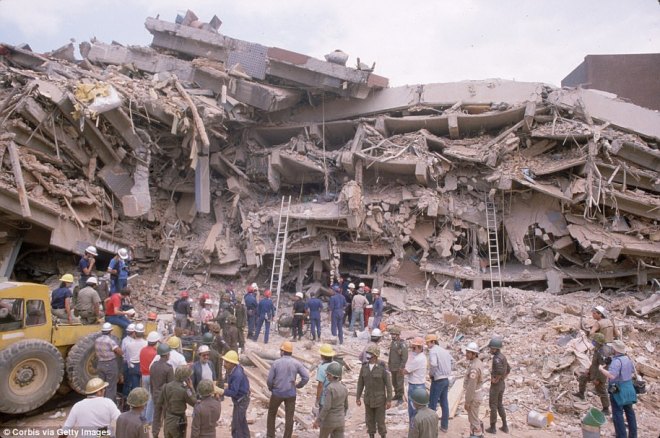
Mexico Crumbles Like A House Of Cards Under The Earthquake.
Aftermath of the destruction, Philadelphia resident stuck at the airport.
Fatal misfortune happened to Mexicans again after 32 years. Two strong 8.1 and 7.1 magnitude earthquakes came together one after another and destroyed Central Mexico.
In 1985 a similar strong quake hit Mexico city on Sept. 19th while on the same day this year people were commemorating and honoring the memory of
10 000 people who died back then. The 19th of Sept. has become twice a fatal rock day in the history of Mexico. According to Mexico authorities as of today at least 326 people have been reported dead or missing.
Rescuers searched for survivors through the night after Tuesday’s powerful earthquake shook Mexico City and surrounding states, killing hundreds and leaving many trapped under collapsed buildings.
According to Mexican Foro TV reports, Luis Felipe Puente, Mexico’s civil protection coordinator said “Efforts to find those who are still trapped in the rubble could last for at least two more weeks and will continue until it is absolutely certain no one else is missing”.
Philadelphia resident David Kieve, being on vacation in Mexico, experienced everything in person:
“I totally didn’t expect my vocation to turn out to a pile of rubbles and debris and national emergency alert. Mexico is a beautiful country and sadly seismic activity is pretty high in this area and you have to be always ready for quakes like this,” said Kieve.
Kieve has been on vocation for two weeks of Sept. from Sept. 5th through 19th, mainly sightseeing the city and getting familiarized with local Mexican bands. David is musician himself, having performed many times at Philadelphia Open Mics and shared some of his “philly music” with local Mexicans.

- David Kieve after arrivial from Mexico City
“I was there, when the first quake hit, it was so quick and unexpected, everybody was in shock. Everybody started running outside in case the building would collapse. During the second earthquake I was at the airport already, ready to take my flight back to Philly, when the ground shook again. Everybody was so scared, some women even cried, all flights were delayed for unknown time. I wasn’t scared anymore, and just tried to hold on to something solid, it was less then a minute, but really strong,” said Kieve.
Earthquake in the eyes of the locals. Rescue mission unites the spirit.
The epicenter of the 7.1-magnitude earthquake was 2.8 miles from San Juan Raboso and 34.1 miles from the city of Puebla, in Puebla state, according to the U.S. Geological Survey.
Thousands of volunteers, rescuers and special operation crews in Mexico city are working side by side to dig through tall piles of rubble from dozens of crumbled buildings. Families wholeheartedly waiting for the hopeful news of their loved one’s.
“My friend Cali Calligari, who is also a musician, was driving with his girlfriend and sister across the city on Tuesday, Sept 19st to visit relatives, when the earthquake happened. His car got stacked and then they had to walk further,” said Kieve.
“When the earthquake happened I was driving and my vehicle got stranded halfway to our destination and we had to walk for about four hours and observe the chaos and what happened to the city. Some of the places I frequently walked by were totally destroyed now. The next 48 hours we were living in fear as we didn’t know what to expect from the Mother Nature, said Calligari.
“My father was in the elevator on the eighth floor, the elevator whipped between the walls. Thanks God, he is ok now and all my family is no longer in danger anymore. However, the tragedy was very devastating and destroyed the city. A lot of people are desperate and sad at the moment, but among all the misfortune there is something beautiful to see – thousands and thousands of volunteers are helping in rescue mission finding people under the debris, providing food and preparing shelters. Earthquake devastations have united people together in spirit of this tragedy and the rescue mission,” said Calligari.
After the earthquake Mexico City and surrounding areas are suffering from electricity outages and water breaks, but even that can’t be compared to misfortune of those who couldn’t stand the earthquake and the grief of families, who lost their loved one’s. Mexicans are trying to help those who suffered from the deadly earthquake locally and in nearby states.
Calligari said “First we were worried about saving our own life and now we are here to help others the way we can. We are even going to other affected states, if there is more aid needed,” said Calligari. “When we save a victim, we sing “El cielito lindo”, which is iconic powerful song in Mexico right now”.
New technological approaches to mitigate the earthquakes.
Besides many volunteers and rescue organizations from the U.S. and Europe, who are trying to help the disaster, a lot of mathematitians and engineeres calculate computational models that helps effectively finding victims under the rubbles and also building low cost sustainable buildings that can survive earthquakes.
Darryl Swofford, a director of Architect Enterprise is putting some ideas on the table to effectively use those resources, when the tragedy like that occures.
«One of course is to build a robust construction with all the sensors and detectors, so then even if the building collapsed, there is a technology in there that helps sensor to detect where the victims are. Unfortunately, it is always a financial challenge for the 3rd world countries, and if doesn’t happen without investment. For us engineers it is a great provision to offer a low cost sustainable model,” said Swofford.
Engineers in CA build shear walls that have the ability to handle and withstand high currents of water and resist lateral forces, produced during earthquakes or wind. These walls are able to withstand shifting up and down and side to side on multiple areas.
“Unfortunately, the costs using shear walls across an entire building structure typically is very high. The approach I was discussing was implementing partial shear walls throughout and placing them into key areas where people typically congregate during a disaster, such as multi-hall interior walls unions or stairwells egress and ingresses during earthquakes, as well as higher floors during wind and water flood,” said Swofford.
When it comes to the first responders in a tragedy like this the first thing is to effectively identify the areas under the rubbles, where people could possibly be, and then find a quick way to get to them.
According to Swofford, one way to do that is to use a thermo imaging. As a person breathing in a confined space, the body is creating more carbon monoxide and carbon dioxide and because of that the air quality changes. Swofford suggests using a technology that picks up the carbon monoxide and carbon dioxide that is stronger in different areas to find people in those pockets, if they are still alive.
Quite often, when the disaster like that occurs, it destructs and paralyzes the service coverage, even when the person is alive, but can’t call.
“Another way could be using sound base technology with the system that can pick up a sound that is coming from underground, using ultrasound and different frequencies, identifying movement and voices,” said Swofford.
Once rescue crews identified where the victims are under the rubbles, they look for optimal ways how to get to them, without further damage. The most traditional way is to use robots that can sneak through the rubbles, but Swofford thinks water can be more effective.
“What I came up with is basically using the water pressure jet to push through that rubble and create a hole that will provide fresh air and water to people and will help them to survive,» said Swofford.
«Articulating water jet can cut through steel and cut through stone and a lot of material very quickly, but also the pressure can quickly be changed. So if It starts to hear something or come close to someone, it may slow itself down, in case it gets to the person and where they are, but it can also be big enough that we can use a straight hole to put something through there, communication, airway, create a food passage and safety materials, like padding and high strength fiber balloons to reduce further injury to victims during debris removal, so its not just creating better safe buildings, but also how do you better find people in massive and horrible tragedy that happened to so many people at once».
 Oksana Ponomarova